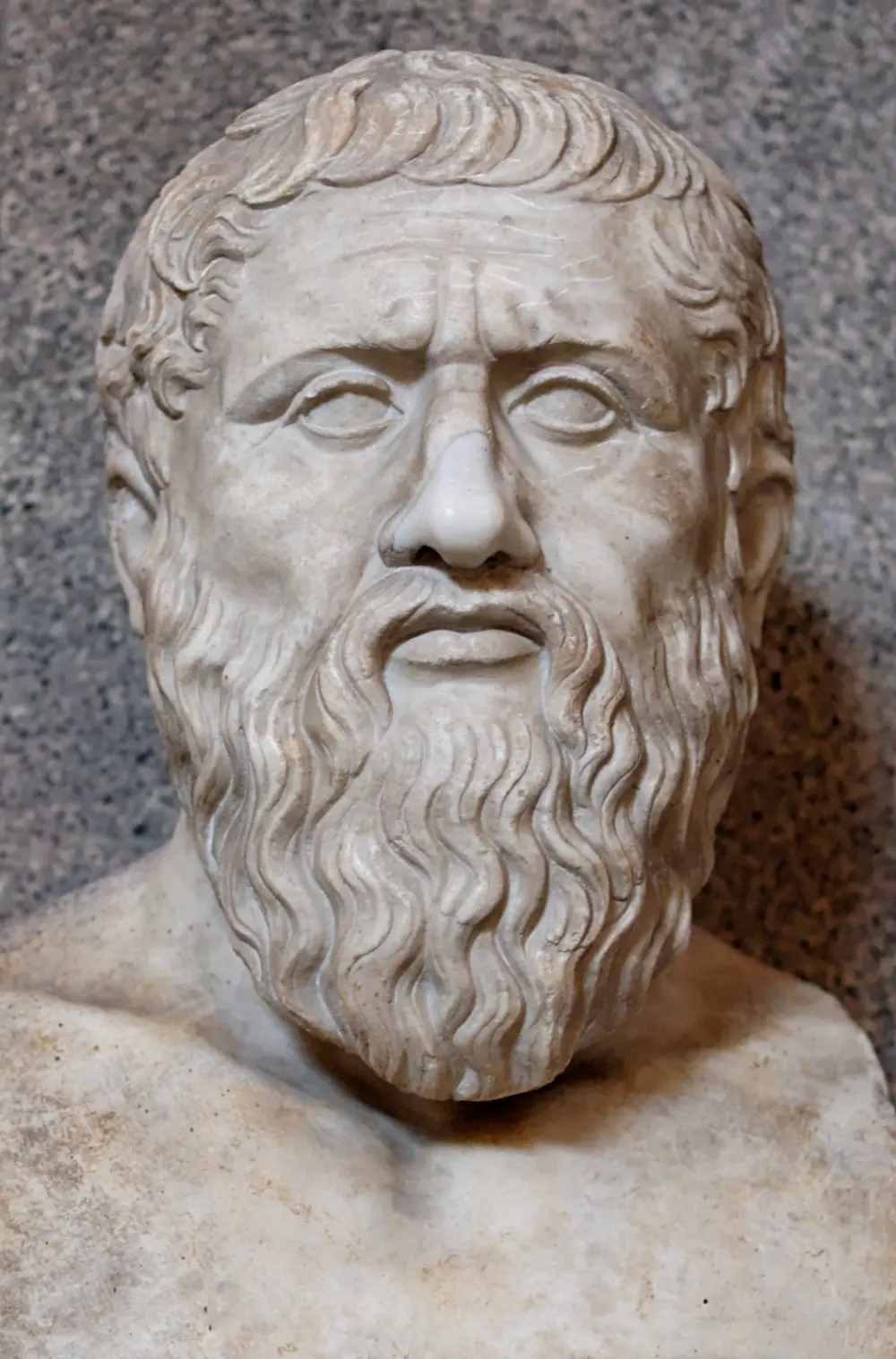
Plato
428–348 BC 11 entries
Biography
Plato was a Greek philosopher from Athens, a pupil of Socrates and the teacher of Aristotle. Born into one of the noble families of the city, he turned to philosophy rather than to politics, and the trial and execution of Socrates in 399 BC marked him for life. He then travelled, three times to the court of the rulers of Syracuse in Sicily, and around 387 BC founded the Academy in a grove outside Athens. The school he started there taught philosophy, mathematics and astronomy for some three centuries.
Unlike nearly all ancient authors, Plato seems to have left us his whole work: some thirty-five dialogues, most of them with Socrates as the main speaker, among them the Apology, the Symposium, the Phaedo and the Republic. In them he set out the theory of Forms, the eternal ideas of which the things of this world are only imperfect copies, and the allegory of the cave, in which people take shadows on a wall for reality. The philosopher Alfred North Whitehead wrote that the European philosophical tradition is a series of footnotes to Plato. He died in Athens around 348 BC.
- Quotes 11